Current Work
My current focus centers the feeding performance and kinematics of the oral jaws in neotropical cichlids. I am broadly interested in rapid ecological niche shifts, especially as they occur during adaptive radiations and species introductions. In cichlids, I am testing for empirical evidence of the long-hypothesized mechanical advantage tradeoff hypothesis, which leads us to expect that teleost fishes should only be able to improve performance in suction-feeding by trading off performance in biting- or benthic-feeding. This expectation is based on the cichlid mandible, which is central to both bite- and suction-feeding, and which is optimized in opposing ways to specialize down either path. (Basically, long-jaws should suck well, and short-jaws should bite well, and no fish can simultaneously have long and short jaws.)
This work centers feeding performance experiments and high-speed filming–and has been one of my greatest joys to do!
Past Research
My journey with research began long before I learned about concepts like the “scientific method.” As a 10-year-old aquarium enthusiast, I coupled boundless curiosity with observation skills and critical thinking to answer questions as best I could.

My passions led me first through science fairs in elementary and middle school, then later through labs built around topics including ornamental fish husbandry, molluscan ecology and sclerochronology, functional morphology, and shape analysis through geometric morphometrics. In all, I’ve worked under Steve Urick, Dr. Laurie Sanderson, Dr. Roger Mann, Dr. Eric Hilton, and now Dr. Peter Wainwright, and have learned tremendously under each.
Undergraduate Honors Thesis
My undergraduate honors thesis focused on the morphological changes that occurred in 3 species of introduced cichlids in Florida after <50 years since their initial introductions. We found that all 3 species demonstrated morphological divergence; however, their patterns of morphological differences were not consistent with one another. We combined linear measurements with a 2D landmark geometric morphometrics and found that in the Mayan cichlid, Mayaheros urophthalmus, introduced specimens occupied a subset morphospace of the native central American specimens with which we compared them. The other two species (Parachromis managuensis and Pelmatolapia mariae) exhibited introduced specimens which occupied some overlap with native specimens, but also some occupation of unshared morphospace.

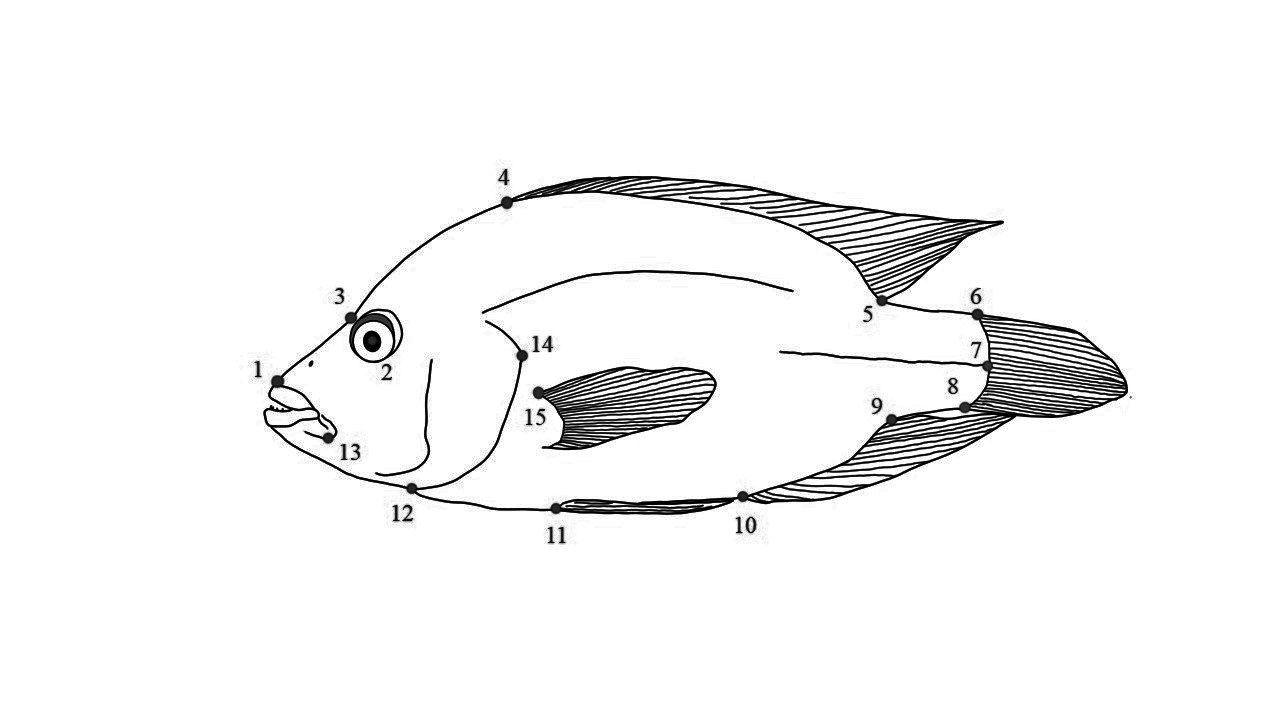

I completed this work under Dr. Eric Hilton at the Virginia Institute of Marine Science and have recently published this work!
 Khalil Russell